
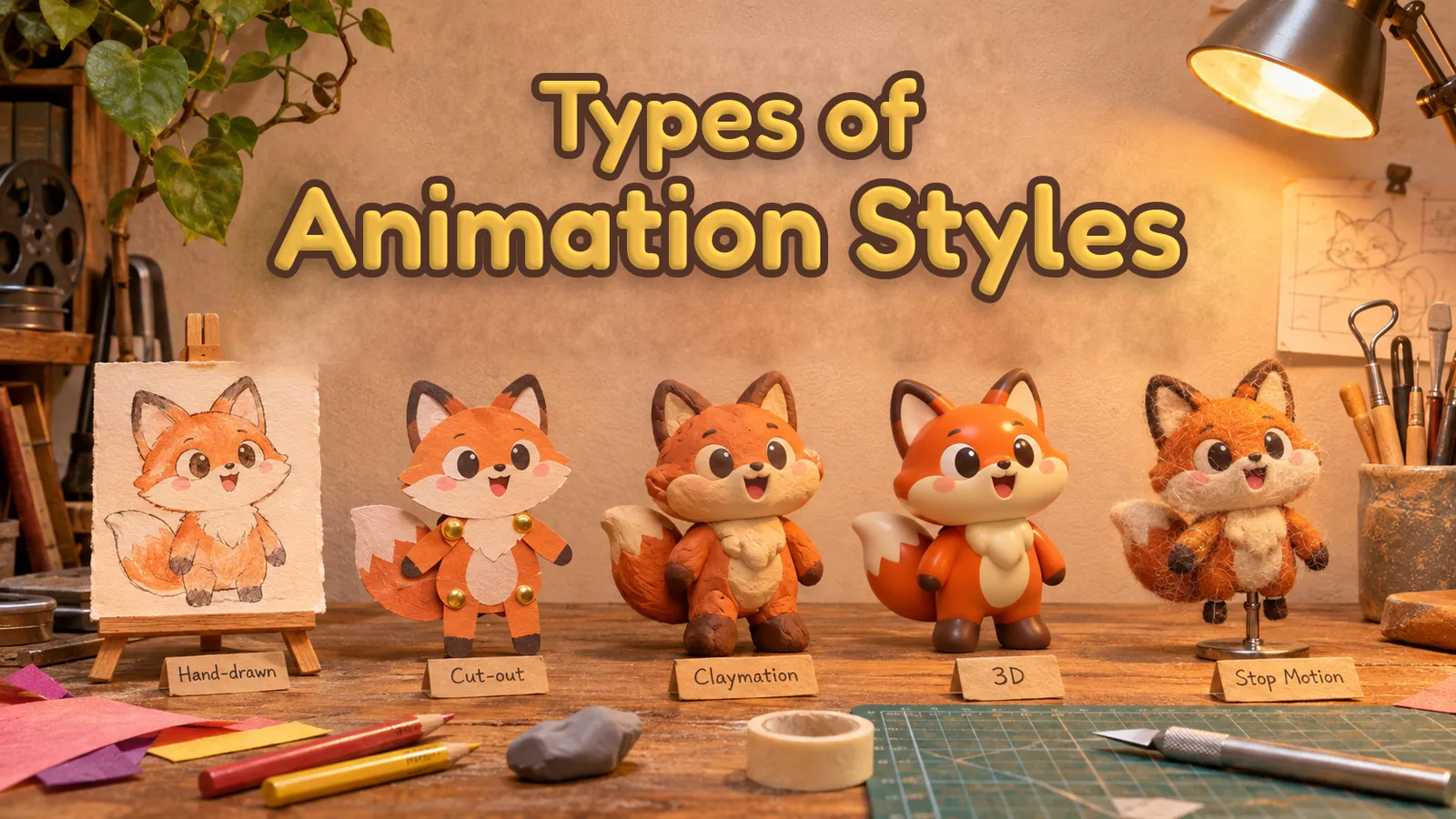
Every animated project starts with the same question: what should it look like? The answer shapes almost everything that follows. It decides who you hire, how the work is built, how fast episodes can be made and how easily the show can grow into a second season.
This guide walks through the main types of animation styles, from hand-drawn classics to modern hybrids, with a well-known example for each. It also explains what each style asks of a production team, which is the part most lists leave out.
What is an animation style?#
An animation style is the combination of technique and look that defines how a piece moves and appears on screen. Technique is how the frames get made: drawn, built in 3D software, photographed or traced. Look is the visual language on top: line weight, colour, shapes, texture and how fluid or snappy the motion feels.
The two are easy to confuse. Spider-Man: Into the Spider-Verse is technically 3D animation, but its look borrows heavily from comic-book printing. That is why people search for the "Spider-Verse animation style" as if it were its own category. In practice, it is.
So when a producer says "we want a 2D animation style", the useful follow-up is always: which kind of 2D?
The main types of animation styles#
Most of the different animation styles you will come across fall into five families: hand-drawn, digital 2D, 3D, physical (stop motion) and graphic (motion graphics). The twelve below cover the styles that buyers actually ask for, grouped roughly in that order.
1. Traditional hand-drawn animation#
Every frame is drawn by hand, originally on paper and then painted onto transparent cels. Disney's Snow White and the Seven Dwarfs (1937) is the landmark, and Studio Ghibli kept the tradition alive long after Hollywood moved on.
The appeal is warmth. You can see the artist's hand in every line. The cost is labour: nothing is reused automatically, so every movement has to be drawn. Today most "traditional" work is drawn digitally on tablets, but the frame-by-frame discipline is the same.
Best for: prestige shorts, title sequences, festival films, anything where craft is the selling point.
2. Digital 2D animation (frame-by-frame and rigged)#
This is the workhorse of modern TV and YouTube. Characters and backgrounds are flat, drawn in software such as Toon Boom Harmony or Adobe Animate, and animated in one of two ways.
Frame-by-frame digital 2D works like traditional animation, just on a screen. Rigged (or "puppet") 2D splits a character into parts, such as head, arms and mouth shapes, and moves those parts on a skeleton. Rigging is what makes long-running 2D series possible. Once a character is built, animators pose it rather than redraw it, and the same rig carries across dozens of episodes.
Best for: episodic kids' series, explainer videos, YouTube channels that need volume at a consistent quality.
3. 3D animation (CGI)#
Characters and sets are modelled in three dimensions, rigged with digital skeletons, then animated, lit and rendered by software such as Maya or Blender. Toy Story (1995) was the first fully computer-animated feature, and the 3D animation style now dominates big-studio films and a large share of preschool TV.
3D asks for more work before the first shot moves: modelling, texturing, rigging and lighting setups all come first. The payoff arrives later. A finished character can be posed from any angle, re-lit for a new scene and reused for years. That is why 3D suits long series and brand mascots. If you are weighing the two head to head, our breakdown of 2D vs 3D animation goes deeper into cost drivers and trade-offs.
Best for: series with a long life, toy and merchandise tie-ins, product visuals, anything that needs camera movement around a character.
4. Stylised 3D (the "2.5D" and painterly look)#
This is the style most people mean when they ask for something "like Spider-Verse" or "like Arcane". The production is 3D, but the render is pushed to look drawn or painted: hand-inked lines, halftone dots, brush textures, 2D effects layered over 3D characters.
Into the Spider-Verse (2018) also animated many scenes "on twos", holding each pose for two frames instead of one, so the motion feels snappier and more like a comic. Arcane (2021) painted textures over its 3D models so every frame resembles an illustration.
On screen it looks effortless. Behind it sit custom shaders, careful lighting and often a 2D pass on top, so stylised 3D suits teams with strong technical artists.
Best for: feature films, premium streaming series, game trailers and campaigns that need to stand out.
5. Anime style animation#
Anime is a Japanese tradition rather than a single technique, but it has a recognisable language: large expressive eyes, detailed backgrounds, dramatic camera angles and "limited" movement, where a character holds still while hair, mouth or background moves.
That economy was partly practical. Osamu Tezuka's Astro Boy (1963) helped prove that a weekly TV series could be animated with fewer drawings if the storytelling and framing did the heavy lifting. Anime style animation still uses that thinking, now mostly in digital 2D, often with 3D for vehicles and crowds.
Best for: teen and young-adult audiences, action and drama, games and music videos.
6. Motion graphics#
Motion graphics animate design elements rather than characters: text, shapes, icons, logos, charts and UI. Saul Bass's title sequences for films like Vertigo are the classic reference. Today the style lives mostly in ads, explainers, app demos and social content, usually built in After Effects.
Motion graphics are fast to produce and easy to update, which is why marketing teams love them. They are weaker at emotion. If the story needs a character the audience cares about, pair motion graphics with character animation rather than relying on them alone.
Best for: explainers, product launches, data-heavy content, social ads, title cards.
7. Stop motion animation#
Real objects are moved by tiny amounts and photographed one frame at a time. Played back, they appear to move by themselves. Puppets, toys, paper and everyday objects all work. Laika's Coraline (2009) is the modern benchmark for puppet stop motion.
Nothing in animation feels more tangible. Audiences can sense that the textures are real. The catch is that mistakes are expensive: a bumped set or a lighting change mid-shot can mean reshooting the whole thing.
Best for: brand films, commercials, music videos, festival shorts, anything that should feel handmade.
8. Claymation#
Claymation is stop motion with sculpted characters made from plasticine or modelling clay, often around a wire armature. Aardman's Wallace & Gromit made the look famous worldwide, thumbprints and all.
Clay is forgiving for squash-and-stretch and facial expression, because the animator literally reshapes the face. It is also fragile and slow. Most modern clay productions use replacement parts, such as pre-sculpted mouths, to keep a schedule.
Best for: comedy, kids' content, ads that want charm over polish.
9. Cut-out animation#
Characters are built from flat pieces, such as paper, card or fabric, and moved under a camera. South Park began this way with construction paper. The show is now made digitally but deliberately keeps its cut-out look.
Digital cut-out is the direct ancestor of rigged 2D. The same idea, jointed flat parts, just lives in software now. It reads as playful and crafted, and it is one of the more economical cartoon style animation options for a long run.
Best for: comedy series, educational content, storybook adaptations.
10. Rotoscoping#
Animators trace over live-action footage frame by frame. Max Fleischer patented the rotoscope in 1917 to give his cartoons lifelike motion. Richard Linklater's A Scanner Darkly (2006) used rotoscoping for an entire feature, and it gives the film its dreamlike, slightly uncanny feel.
Rotoscoping is the shortcut to realistic human movement. Dance, sport and complex physical action all benefit. It also has a second life in visual effects, where "roto" means tracing around objects so they can be separated from the background.
Best for: music videos, realistic action, documentary-style animation, VFX cleanup.
11. Rubber hose animation style#
Rubber hose is the look of 1920s and 1930s American cartoons: limbs that bend like hoses with no elbows or knees, white gloves, pie-cut eyes and bouncy, rhythmic movement. Early Mickey Mouse and Fleischer's Betty Boop are the classic examples, and the game Cuphead (2017) brought the rubber hose animation style back to a whole new generation.
Because it is so recognisable, it works as instant nostalgia. It is also simpler to animate than realistic anatomy, since the limbs follow smooth curves.
Best for: retro branding, games, music videos, mascots with personality.
12. UPA animation style (limited and graphic)#
In the late 1940s and 1950s, the studio UPA (United Productions of America) rejected Disney-style realism. Its films used flat colour, bold geometric shapes, minimal backgrounds and limited movement. Gerald McBoing-Boing (1950) won an Oscar and proved that design could carry a cartoon.
The UPA animation style shaped much of the TV animation that followed, from mid-century commercials to modern flat-design explainers. When the design is strong enough, limited movement stops looking cheap and starts looking deliberate.
Best for: stylish ads, design-led brands, educational content, title sequences.
How to choose the right animation style for your project#
Taste matters, but fit matters more when picking from the different animation styles. Four questions settle most decisions.
- Who is watching? Preschool audiences respond to clean shapes, bright colour and clear faces. That usually means rigged 2D or soft-lit 3D. Teens and adults will accept far more stylisation, from anime to painterly 3D.
- How much will you make? A single 60-second film can justify hand-drawn or stop motion. A 52-episode series needs a style where characters, sets and props can be reused, so rigged 2D or 3D almost always wins.
- What does the brand already look like? If there is an existing illustration style, a book or a mascot, the animation should extend it, not fight it. Cut-out or rigged 2D often translates illustration most faithfully.
- What will the content need to do next? Toys, games, AR filters and merchandise all reuse 3D assets easily. If spin-offs are on the roadmap, building in 3D early can save rebuilding later.
Whichever way you lean, lock the style before production begins. Style frames, a character model sheet and a short animation test show everyone exactly what the finished piece will look like. An animatic then shows whether the timing works. This is the core job of a studio's pre-production services, and it is far cheaper to change a style frame than a finished episode.