
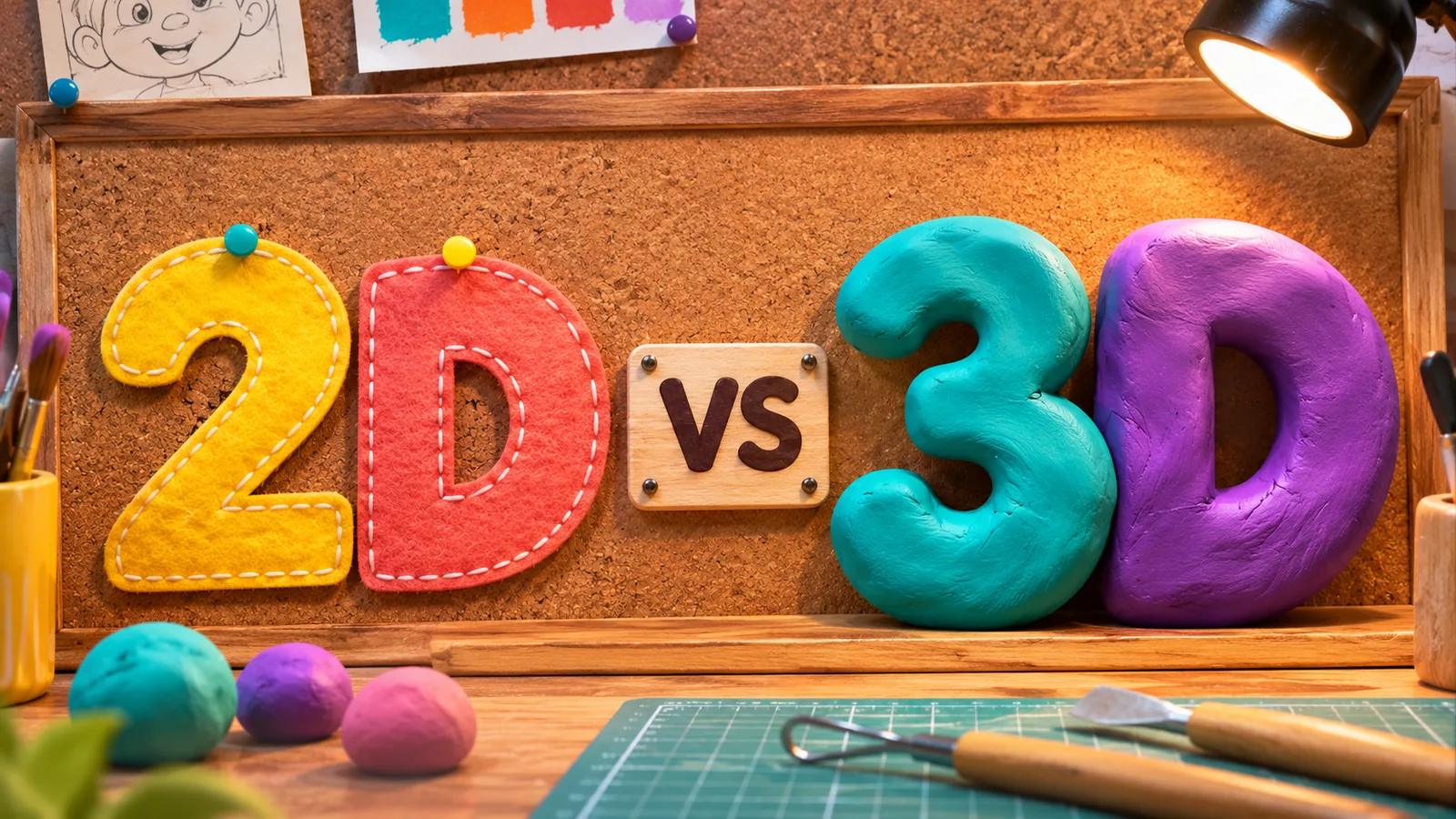
2D vs 3D animation is one of the first decisions in any animated project, and it shapes everything after it: how the film looks, how it is made, how long it takes and what it costs. This guide explains the difference between 2D and 3D animation in plain terms, compares the cost of each, shows real examples, and ends with a simple checklist for choosing the right one.
What is the difference between 2D and 3D animation?#
The difference between 2D and 3D animation comes down to space. 2D animation exists on a flat plane with height and width only. 3D animation exists in a virtual space with height, width and depth, so objects can be viewed from any angle.
In practice, that changes how the work is done:
- In 2D, characters are drawn, or built from flat rigged pieces. If a character needs to turn around, an artist draws the new view.
- In 3D, characters are built once as digital models, given a skeleton (a rig), textured and lit. After that, animators pose them like puppets and a virtual camera films them from any position.
Neither style is more advanced than the other. They are two different ways of making moving images, each with its own strengths.
2D vs 3D animation at a glance#
| 2D animation | 3D animation | |
|---|---|---|
| Space | Flat: height and width | Virtual 3D space: height, width and depth |
| How characters are made | Drawn or built from flat rigged parts | Modelled, textured and rigged digital puppets |
| New camera angle | Needs new artwork | Move the virtual camera |
| Look | Stylised, graphic, expressive | Depth, realistic lighting, volume |
| Up-front work | Lighter | Heavier (modelling, rigging, texturing) |
| Asset reuse | Limited | High: models and sets carry across scenes |
| Common software | Toon Boom Harmony, Adobe Animate, TVPaint | Blender, Maya, Houdini |
How 2D and 3D animation are made#
Both 2D and 3D animation follow the same three phases: pre-production, production and post-production. Where the effort sits is what differs.
Pre-production is shared. Every project starts with a script, a storyboard and an animatic, which is a rough timed version of the film built from the storyboard frames. Character and background designs are locked here. This is the cheapest stage to make changes, so most of a project's cost is decided before any animation starts.
2D production focuses on drawing. Animators create key poses, fill in the in-between frames (or move rigged cut-out characters), then colour and clean up the frames. Backgrounds are painted separately.
3D production front-loads the build. Before anything moves, each character and set is modelled, textured and rigged. Then animators block out the motion, refine it, and the scenes are lit and rendered. Rendering, where the computer turns each frame into a final image, can take significant machine time on detailed shots.
Post-production is similar for both. Compositing (combining all the layers into the final frame), sound design, music and the final edit.
2D vs 3D animation cost#
Most animation studios price work per second or per minute of finished animation. The format matters, but it is not the only thing that sets the price.
What drives 2D animation cost.
- The number of characters and how detailed they are
- Frame-by-frame drawing versus rigged cut-out animation (rigged is usually faster)
- Background painting and how many locations the story needs
What drives 3D animation cost.
- Building the assets: every character, prop and set has to be modelled, textured and rigged before animation starts
- Lighting and rendering time, especially for realistic materials, hair, water or crowds
- Camera complexity and the number of unique shots
Costs that apply to both. Script and storyboard work, voice-over, music, the number of revision rounds and the delivery deadline. Changes after the animatic is approved cost far more than changes made before it.
Is 3D animation cheaper than 2D?#
For a single short video, 3D is usually the more expensive option, because every asset has to be built before a frame is animated. Over a long series the gap narrows. A rigged 3D character can be reused, re-posed and re-lit across many episodes, while a 2D character still needs new drawings for every new action and angle. If you are making one short explainer, 2D is often the lower-cost route. For a recurring series with a fixed cast, get a per-episode quote in both formats before deciding.
2D vs 3D animation examples#
Seeing both styles side by side makes the difference obvious:
- 2D animation: Studio Ghibli's Spirited Away, Disney's original hand-drawn The Lion King, The Simpsons, most anime series, and many explainer videos you see on websites.
- 3D animation: Pixar's Toy Story, Disney's Frozen and Encanto, most modern feature films, product demos and architectural walkthroughs.
- Both together: Spider-Man: Into the Spider-Verse and Arcane use 3D models with hand-drawn or painted finishes, which is why they look like neither pure style.
Kids' content uses both styles heavily. Browse the top kids animation channels on YouTube and you will find 2D and 3D shows competing for the same audience.
Pros and cons of 2D vs 3D animation#
| 2D animation | 3D animation | |
|---|---|---|
| Pros | Expressive, stylised look with full artistic control | Free camera movement and real depth |
| Faster to start, with no 3D asset library to build first | Realistic lighting, materials and physics | |
| Usually the lower-cost option for short, one-off pieces | Rigged characters and sets are reused across episodes | |
| Cons | Every new angle or action needs new drawings | Heavy up-front build before anything moves |
| Complex camera moves through space are hard to fake | Rendering adds machine time and cost | |
| Limited asset reuse across long series | A highly stylised, hand-drawn feel takes extra work to achieve |
Can 2D and 3D animation be combined?#
Yes. Combining 2D and 3D animation is common, and the mix can take several forms:
- 2D characters animated over 3D-built backgrounds, for smooth camera moves
- 3D characters rendered with flat, hand-painted shading so they read as 2D
- 2D effects such as smoke, sparks and splashes layered over 3D shots
A hybrid works best when one team controls both pipelines, so lighting, line weight and timing match across the two styles.
2D vs 3D animation: which should you choose?#
Answer these five questions and the right format usually becomes clear:
- Is it one video or a series? A single short piece leans 2D. A long series with a recurring cast leans 3D.
- Does the camera need to move through space? If yes, choose 3D.
- What look do you want? Graphic and expressive suits 2D. Realistic depth and lighting suit 3D.
- How many characters and locations? These drive cost more than the format does.
- Where will it be watched? Platform, aspect ratio and episode length all affect the pipeline.
If you have settled on 2D and are comparing studios, this guide to the best 2D animation studios in India is a useful starting point.
The bottom line#
2D vs 3D animation is a choice between two ways of spending a budget. 2D puts the effort into drawing and suits stylised, short and fast-turnaround work. 3D puts the effort into building assets up front and pays it back across series, product work and anything that needs real camera movement. Many of the best projects use a little of both.
Need help deciding? Monal Digital is a full-service 2D and 3D animation studio in India, handling everything from pre-production services to 2D and 3D animation services for clients worldwide. Share your script or brief and we will recommend the right format. Talk to us.