
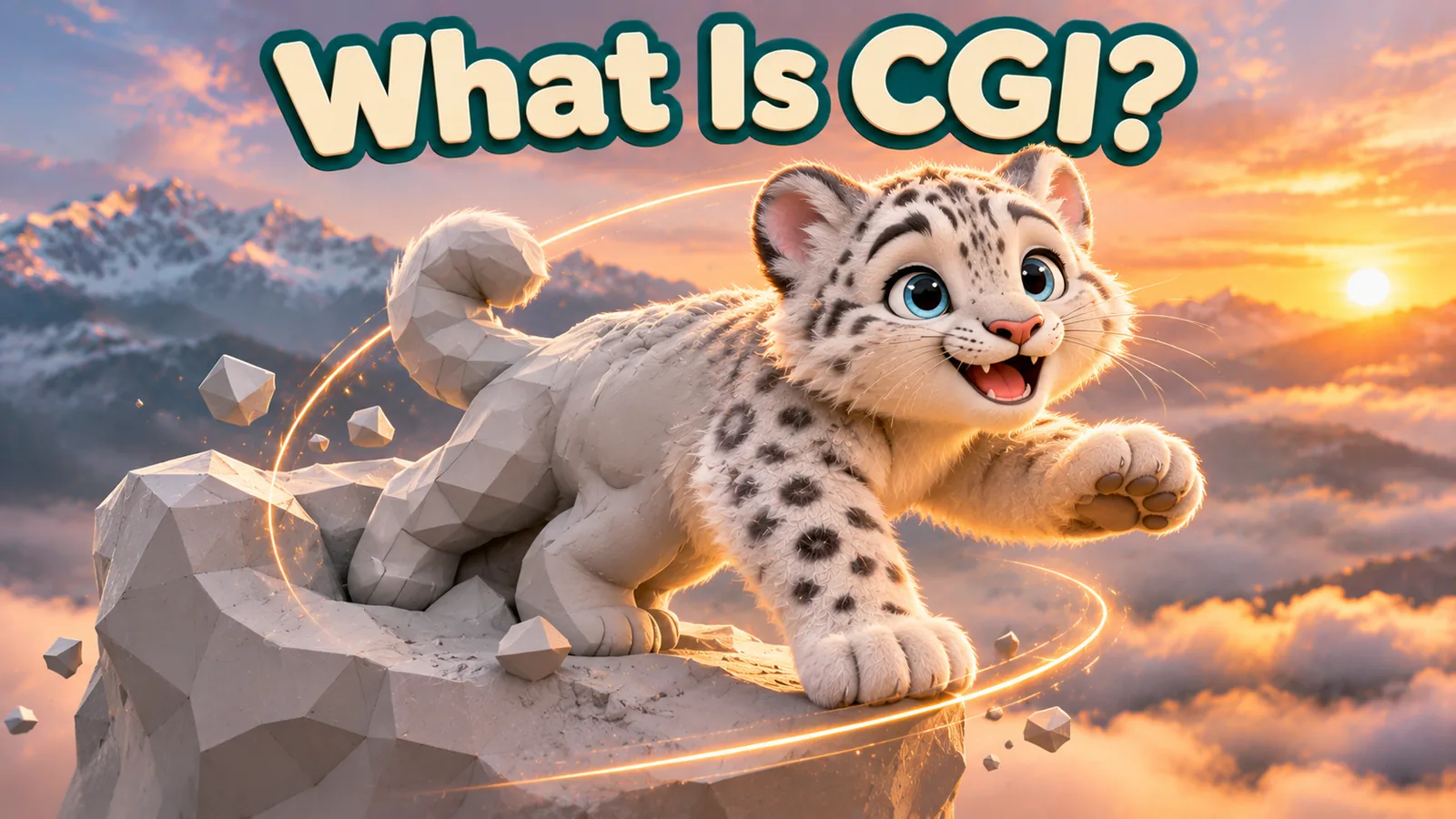
CGI is everywhere, from the dinosaurs in Jurassic Park to the product shot in last night's phone ad. Yet ask most people what is CGI, exactly, and the answer gets vague fast. This guide explains it in plain words: what CGI means, how a CGI shot is actually made, where it shows up beyond films, and how CGI differs from VFX, animation and AI.
What is CGI? The short answer#
CGI stands for computer-generated imagery. It means any image, still or moving, that is created with computer software instead of being captured by a camera. A 3D cartoon character, a digital city skyline, a rendered sneaker on a white background: all of it is CGI.
That is the whole CGI meaning in one line. If you have searched for the CGI full form, or what does CGI stand for, the answer is the same: computer-generated imagery. (In web development, CGI can also mean Common Gateway Interface, and CGI is the name of an IT company. Neither has anything to do with film or animation.)
In practice, when people in film, advertising and animation say CGI, they almost always mean 3D work: objects and characters built as digital models, then lit and rendered into images.
How is CGI made? The pipeline step by step#
So what is CGI in terms of real work? It is a pipeline. Every shot, from a feature film to a 20-second ad, moves through roughly the same stages.
Concept and planning. Designs, storyboards and an animatic decide what will be built before anyone opens 3D software. This is the job of pre-production services, and it saves the most money of any stage.
Modelling. Artists build each character, prop and set as a 3D model, a mesh of points and polygons.
Texturing and shading. Surfaces get colour, pattern and material: fur, skin, metal, fabric, glass.
Rigging. Characters get a digital skeleton and controls so animators can pose them.
Then comes the part most people picture when they think of CGI.
Animation. Animators move the rigs frame by frame or pose to pose, giving the performance its timing and personality.
Lighting. Virtual lights are placed, just as a cinematographer would light a set.
Rendering. The computer calculates the final image for every frame. Detailed shots can take a long time per frame, which is why studios use render farms.
Compositing. Rendered layers are combined, colour-graded and finished.
The most common CGI software includes Autodesk Maya, Blender, Houdini for simulations such as water and smoke, ZBrush for sculpting, and Unreal Engine for real-time work.
What is CGI animation?#
When the whole film is built this way, with no live-action footage at all, it is called CGI animation or 3D animation. Toy Story (1995) was the first fully computer-animated feature, and today most big-studio animated films, and a large share of kids' TV and YouTube content, are made this way.
The difference from 2D animation is depth. A 2D character is drawn flat. A 3D character is a model that can be turned, lit and filmed from any angle, which makes it easy to reuse across many episodes. Our comparison of 2D vs 3D animation goes deeper into how the two styles differ in look, workflow and cost drivers.
What is CGI in movies? A short history#
CGI in movies arrived in small steps before it took over.
- 1973, Westworld: the first feature film to use digitally processed images, for a robot's pixelated point of view.
- 1982, Tron: long sequences of computer-generated environments and vehicles.
- 1991, Terminator 2: the liquid-metal T-1000, a landmark digital character in a live-action film.
- 1993, Jurassic Park: computer-generated dinosaurs combined with practical animatronics, proving digital creatures could look real.
- 1995, Toy Story: often called the first CGI movie, because it was the first feature made entirely with computer animation.
The studios behind several of these moments, including Pixar, appear in our list of animation studios that changed the film industry.
CGI vs VFX: what's the difference?#
People use the two terms as if they mean the same thing. They overlap, but they are not identical.
What is VFX? VFX, short for visual effects, covers any imagery added to or changed in live-action footage after it is shot. That includes CGI, but also compositing, green-screen keying, wire removal, digital set extension and colour work.
CGI is one of the tools VFX artists use. It is also used on its own, with no live footage at all, as in a fully animated film.
| CGI | VFX | |
|---|---|---|
| What it is | Imagery created entirely in software | Any effect added to or changed in filmed footage |
| Needs live-action footage? | No | Usually yes |
| Example | A fully animated 3D film or a rendered product shot | A CGI creature composited into a real street scene |
So when someone asks what is CGI and VFX together, the simplest answer is: CGI makes the digital elements, and VFX blends them into the real shot. All CGI in movies with real actors is VFX work, but not all VFX is CGI.
CGI vs animation#
Animation is the broader art of making things move, whether by hand drawing, stop motion, 2D software or 3D software. CGI animation is one branch of it. And CGI is not always animated: a single rendered image, such as a car advert still or an architectural visual, is still computer-generated imagery, with no animation at all.
Where CGI is used beyond films#
CGI advertising. Brands render products before they physically exist and create impossible ads, like the giant mascara brush Maybelline sent past London trains in 2023. These "fake out-of-home" campaigns are fully computer-generated.
Kids' series and YouTube. Bright, rounded 3D characters are the standard look for a large share of preschool content, because rigs can be reused across hundreds of episodes.
Games. Every character and environment in a modern 3D game is built and rendered this way, in real time.
Architecture and products. Buildings, interiors and products are visualised long before anything is built.
Education and medicine. 3D visuals show what a camera cannot, such as the inside of a heart or the orbit of a planet.
Is CGI the same as AI?#
No. CGI effects are built by artists using software, with every model, rig, light and frame controlled by a person. AI image and video tools generate pictures from text prompts or training data, and the artist does not build what is inside the frame.
The two are starting to mix in some pipelines, but they are different crafts. For projects where consistency, brand accuracy and character control matter, such as a long series or a brand mascot, artist-built 3D work remains the reliable route.