
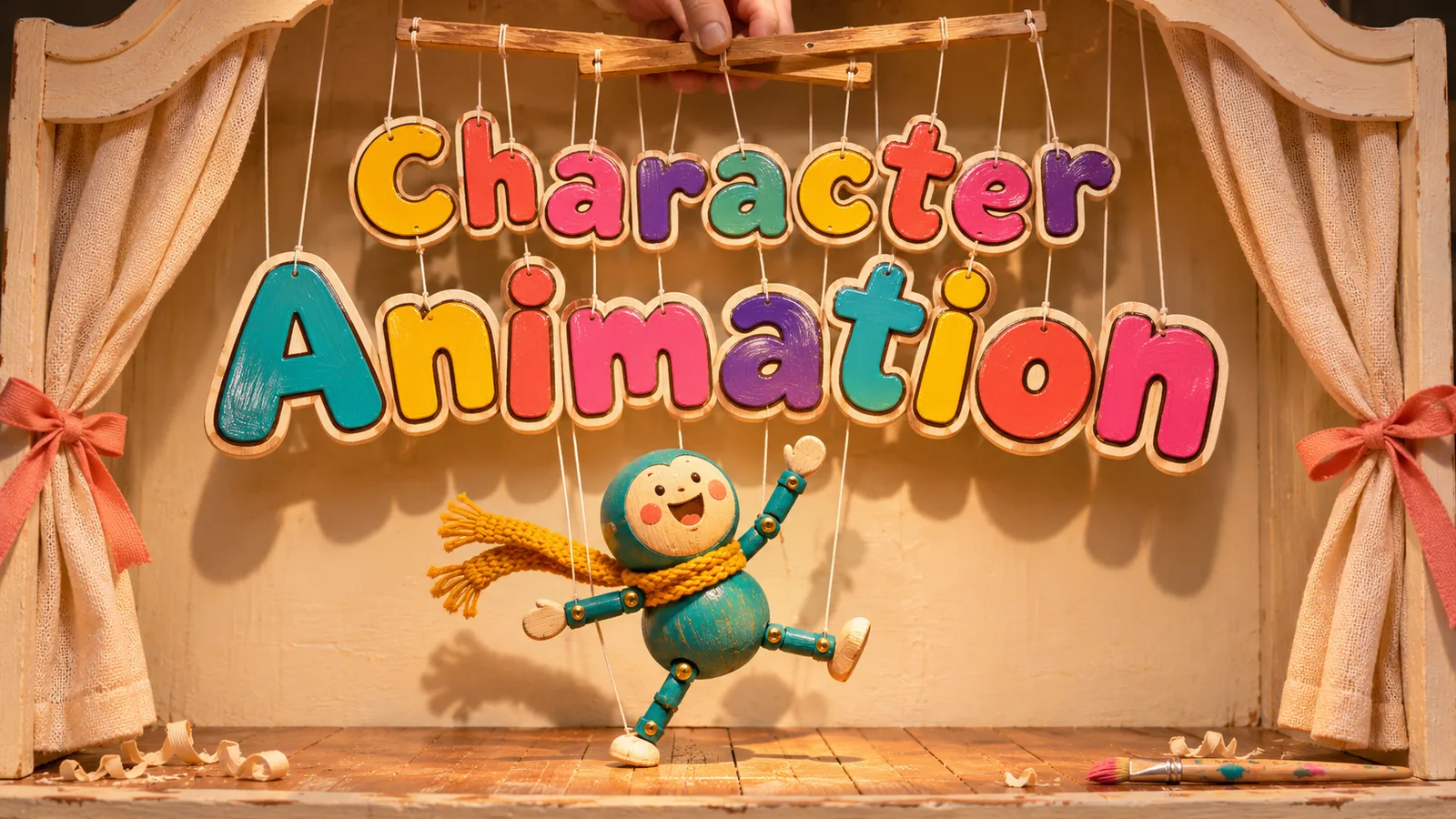
Character animation is the part of a production your audience actually falls in love with. People forget backgrounds and camera moves; they remember how a character walked into the room, how its face fell when the news was bad, how it laughed. This guide explains what it is, the building blocks that make a performance believable, how it's done in 2D and 3D, and what to look for when you're reviewing animation from a studio.
What Is Character Animation?#
Character animation is the craft of making an animated character move, think and feel like a living being. It's less about moving a drawing or a model from point A to point B and more about performance: the animator decides how the character thinks, what it wants and how that shows in its body and face.
That's why animators are often described as actors with a pencil or a mouse. A good one doesn't just animate a wave. They animate a nervous wave, a proud wave, or a wave that stops halfway because the character just remembered something.
Why Character Animation Makes or Breaks a Project#
Viewers forgive a simple background. They don't forgive a character that feels stiff, floaty or fake. Weak animation breaks the illusion within seconds, and once the audience stops believing in a character, they stop caring about the story.
For kids' content, brand mascots and YouTube series, the stakes are even higher. Children read emotion from movement long before they follow a plot, and a brand mascot only works if people like it. Strong animation is what turns a design into someone the audience wants to watch again.
The Building Blocks of Great Character Animation#
Every convincing performance is built from the same few layers.
Body Mechanics: Weight, Balance and Timing#
Before a character can act, it has to obey physics. Body mechanics is how weight shifts when a character stands up, how momentum carries through a jump and how a heavy character moves differently from a light one. Animators lean on the classic principles of animation here: anticipation before an action, follow-through after it, squash and stretch, arcs and easing in and out of poses.
The Walk Cycle#
The walk cycle is a short loop of animation showing a character taking a full stride. It's one of the first things animators build for a new character, because a walk reveals personality instantly. A confident character struts, a tired one drags its feet, a sneaky one tiptoes. In a series, a well-built walk cycle is reused across many scenes, so it has to be right.
Acting and Body Language#
This is where the character starts to think. Acting choices cover the poses, gestures and pauses that show what's going on inside a character's head. Animators often film themselves performing a line as reference, then exaggerate and simplify it to suit the character's design and style.
Facial Animation#
The face carries most of the emotion. Facial animation covers eyebrows, eyelids, eye direction, cheeks and mouth working together. Small details matter here: a blink at the right moment, the eyes moving a split second before the head turns, a smile that reaches the eyes. These are what make a character feel present rather than puppeted.
Lip Sync Animation#
Lip sync animation matches the character's mouth shapes to recorded dialogue. Animators break the audio down into sounds and match each one to a mouth shape from the character's design sheet. Good lip sync is never just flapping the jaw. The whole face and body move with the voice, so the line feels like it's coming from the character, not dubbed over it.
2D vs 3D Character Animation#
The goals are the same in both, but the tools and workflow are different.
2D character animation is built either frame by frame, with key poses drawn by hand and in-betweens filling the gaps, or with rigged characters made of separate parts that move and rotate. Frame-by-frame work gives the most expressive, elastic motion; rigged 2D is faster and more consistent across long series.
3D character animation starts with a model built in software like Blender or Maya. Before anyone can animate it, the model goes through character rigging: a rigger builds a digital skeleton and a set of controls for the body and face. Animators then pose those controls at key moments and refine the motion frame by frame.
If you're still deciding between the two, our guide to 2D vs 3D animation walks through the trade-offs.
How a Studio Animates a Character, Step by Step#
Here's how a character's performance typically moves through a professional pipeline.
- Design. The character is designed and locked on a model sheet with its turnaround, expressions and mouth shapes. This happens in pre-production services, alongside the script and storyboard.
- Planning the shot. The animator studies the storyboard and animatic, listens to the dialogue, and gathers reference, often filming themselves acting the scene.
- Rigging (3D and rigged 2D). The character gets its skeleton and controls so it can be posed.
- Blocking. The animator sets the key poses that tell the story of the shot. At this stage the motion looks choppy, and that's intentional. This is where the director gives acting notes.
- Splining and in-betweening. The movement between key poses is filled in and smoothed, so the action flows.
- Polish. Fine details are added: overlapping action in hair and clothes, eye darts, blinks, breathing, the final layer of facial animation and lip sync.
- Review. The director and client review the shot, give notes, and the animator revises before it moves to lighting and compositing.
Blocking is the most important checkpoint for a client. Changes to acting are cheap at blocking and expensive after polish.
What to Look For When You Review Character Animation#
You don't need to be an animator to judge a performance. Watch each shot with these questions in mind:
- Does the character feel heavy enough? Feet should plant on the ground, and bodies should react to stopping and starting.
- Can you tell what it's thinking? Even without dialogue, the pose and face should tell you the character's mood.
- Do the eyes lead? Characters that look before they move feel alive. Characters that move like a block feel robotic.
- Is the lip sync believable? The mouth should hit the strong sounds, and the face should move with the voice.
- Is it on model? The character should look like its design sheet in every frame.
- Does it suit the audience? Preschool content usually wants clear, readable, gentle motion. Older audiences can handle faster, more complex action.