
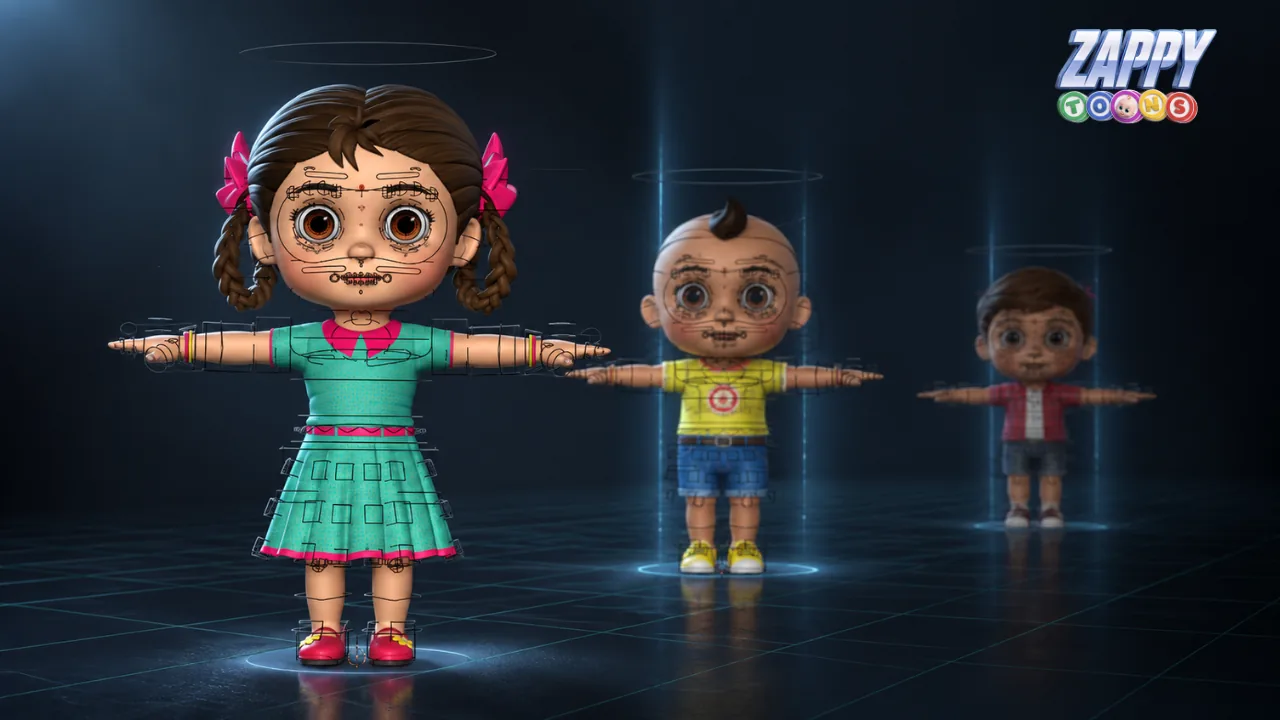
Monal Digital is the animation studio that makes it: a full-service, pre-to-post production studio in Haldwani, Uttarakhand, incorporated in March 2020, working across both 2D and 3D.
This is how the channel got there.
It started in 2017, and never stopped#
Zappy Toons launched on 8 June 2017 and has been in continuous production since.
That sentence is the single biggest reason the numbers look the way they do, and it's the least exciting answer anyone wants to hear. There was no viral moment. There was a weekly publishing schedule held for nine years.
Kids content compounds in a way almost no other category does. An episode published in 2018 is still being watched in 2026, because the pre-school audience turns over completely every few years and arrives with no idea what's old. Nothing in the catalogue ages out.
Which means the only real way to lose is to stop. And channels in this category rarely stop because the creative failed. They stop because production capacity ran out.
The decision that shaped everything: publish weekly#
Committing to a fixed weekly release is easy to say and structurally expensive to deliver.
A single new Zappy Toons episode takes 20 to 22 days from approved script to render-complete. A new episode publishes every 7 days.
Those two numbers don't reconcile unless the animation pipeline is built differently. A 22-day episode on a 7-day release cycle means roughly three episodes are in production simultaneously: one being modelled, one being animated, one in lighting and render, all moving at once.
That staggered animation production pipeline is what made the cadence survivable. It's also the hardest thing to establish and the easiest thing to break. Every stage has to stay continuously fed. A modeller idle for three days costs as much as a compositor running three days late. One wastes capacity, the other misses an upload.
Most studios can make one good episode. Building a system that produces three in parallel, every week, for nine years, is a different problem.
The stages#
The pipeline moves through modelling, rigging, animation, lighting and render, then compositing, with pre-production ahead of it and edit, music, and publishing behind it.
The role distribution tells you where the weight sits. Five animators against one rigger and one compositor is not an arbitrary split, it reflects where the hours actually go in character-led pre-school content. Animation is the bottleneck stage, so it gets half the team. Rigging and compositing are lower-volume per episode once the foundations exist, so they run lean.
Getting that ratio wrong is how pipelines stall. Too few animators and the middle of the pipeline backs up. Too many and you starve them.
Asset reuse within a theme#
Within the same theme or channel, assets are reused rather than rebuilt.
This is why one rigger can support five animators. A character rigged once serves every subsequent episode that character appears in. Environments built for one story carry into the next. The rigging and modelling load is front-weighted: heavy early, lighter as the library for that theme fills out.
It also solves consistency automatically. The characters in episode 900 look like the characters in episode 90 because they are the same assets, not a careful reproduction of them. On a pre-school channel that matters more than it sounds: young viewers recognise characters before they follow stories, and a character that drifts visually stops being recognisable.
The team stayed small on purpose#
The Zappy Toons 3D animation pipeline runs on ten people:
- 5 animators
- 2 modellers
- 1 rigger
- 1 lighting and render artist
- 1 compositor
The split is where the growth logic shows. Five animators against one rigger and one compositor isn't arbitrary. It puts half the team on the stage where the hours actually go in character-led pre-school content. Animation is the bottleneck, so it gets the weight. Rigging and compositing run lean because, once the foundations exist, their per-episode load drops.
Get that ratio wrong and the pipeline stalls. Too few animators and work backs up mid-pipeline. Too many and they sit waiting on assets.
The compounding asset library#
Within the same theme or channel, assets are reused rather than rebuilt.
This is the mechanism that turned a weekly schedule from unsustainable into routine. A character rigged once serves every episode that character appears in afterwards. Environments built for one story carry into the next. The modelling and rigging cost is front-loaded: heavy at the start of a theme, progressively lighter as its library fills out.
So the channel got faster as it got older. Episode 800 was cheaper to produce than episode 80, not because the team cut corners but because most of what it needed already existed.
It also fixed consistency without anyone managing it. The characters in episode 900 look like the characters in episode 90 because they are literally the same assets. Young viewers recognise characters before they follow stories, and a character that drifts visually stops being recognisable.
Making the catalogue work twice#
Once the library was deep enough, it started doing a second job.
Every week, Zappy Toons publishes:
- One 30-minute compilation
- One 60-minute compilation
- One new video
- Two shorts
- Live streaming
Only one of those is new animation. The rest is the catalogue working, and deciding that split is YouTube channel management as much as it is production planning.
The compilations are the highest-leverage decision on the channel. Ninety minutes of weekly programming, assembled from episodes that already exist and have already been paid for. Every episode gets a second working life, and the channel gets long-session content without a single new frame of 3D animation.
That format works because of how pre-school content is consumed. A parent presses play and walks away. They are not selecting the next video. Whatever holds the screen for the next forty minutes is what gets watched, and a four-minute rhyme hands that decision back to autoplay every four minutes. A 60-minute compilation matches the behaviour, and session length is what YouTube's distribution rewards.
Shorts do the opposite job: cheap discovery cut from existing assets. Live keeps the channel present between uploads. It's a YouTube animation strategy built around one asset base rather than constant new production.
Built in Hindi, not dubbed into it#
Zappy Toons publishes in Hindi, with script, voice, music, and lip-sync produced natively, not laid over an English master.
That was a growth decision as much as a creative one. Dubbed content reads as dubbed, and mismatched lip-sync is the first thing that breaks the illusion for a small child. Building language-first costs more per episode and complicates scheduling. It's also why the channel holds an Indian audience at this scale rather than skimming one.
Why none of it broke: everything in-house#
Animation, music, voice, editing, thumbnails, and YouTube channel management all sit inside Monal Digital.
No vendor queue between a finished render and a published video. No waiting on an external editor to turn around a compilation cut. No gap between a production team and a channel team working from different calendars.
When the animation pipeline and the publishing schedule live in the same building, they are the same schedule. That's the difference between a channel that publishes weekly and one that has published weekly since 2017.
What this looks like from a commissioning seat#
Monal Digital LLP was incorporated in March 2020 and works from Haldwani, Uttarakhand. It operates as both a 3D and a 2D animation company, with full pre-to-post production across both.
Zappy Toons isn't offered here as a subscriber number. It's evidence of what a commissioned series actually needs: a 22-day build cycle held against a 7-day delivery date, roughly a thousand times, with consistent assets and no gaps.
If you're pricing schedule risk on a slate, that's the record worth checking.
Talk to Monal Digital about 3D animation services or 2D animation services for your next production.