
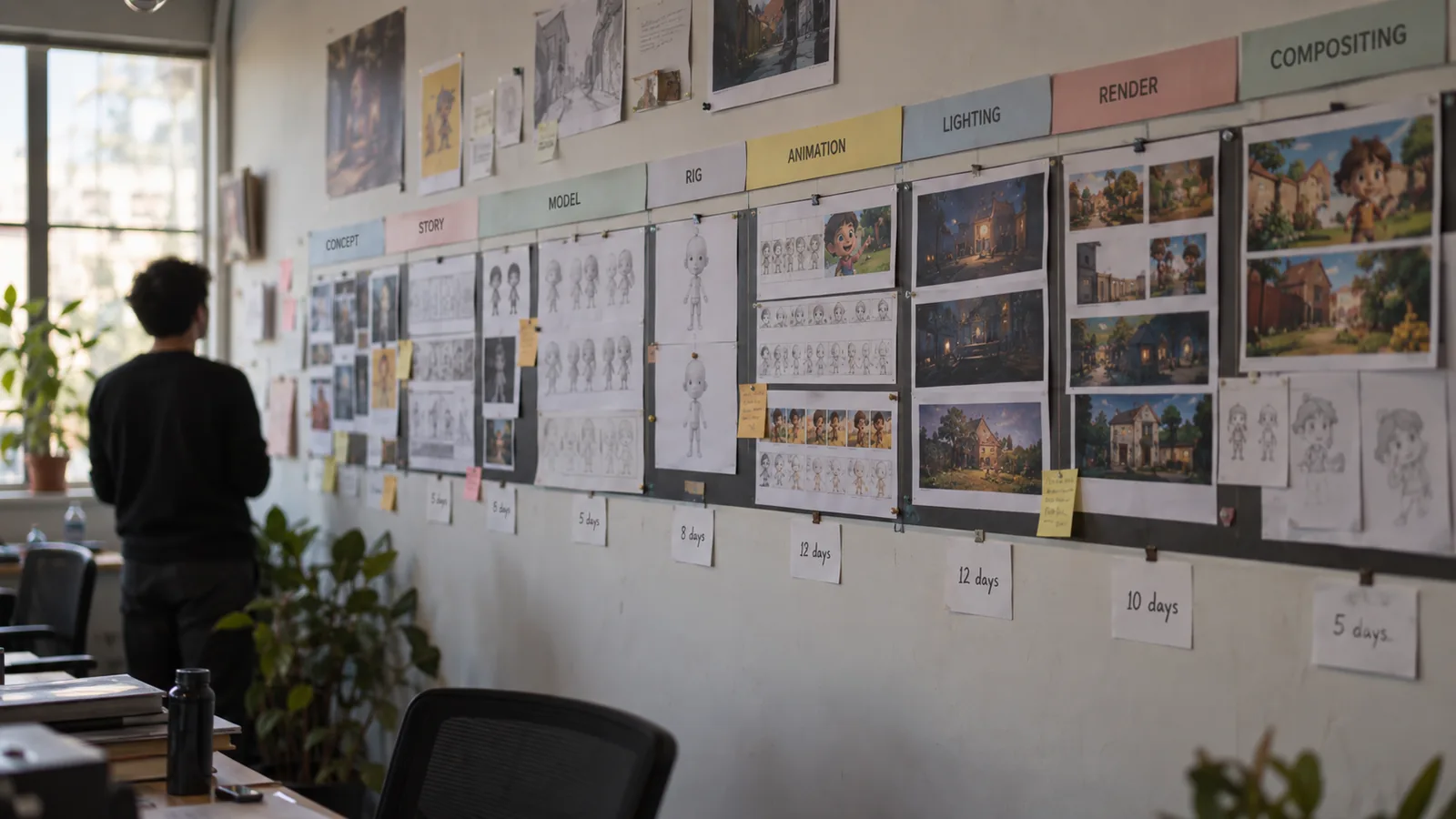
The explanation lives in the stages. What each one involves, why it takes what it takes, and how much of it happens at the same time.
Here's the whole 2D kids animation production process, stage by stage, with real durations from a working pipeline. Twelve episodes, three minutes each.
Figures from Monal Digital, based on a three-minute episode in a twelve-episode series. A baseline, not a quote.
The stages, one by one#
1. Script and concept#
Duration. One to two days.
The episode gets written. Story beats, dialogue, what each character wants, what stops them getting it.
It is the shortest stage and the one with the most leverage, because everything after it is an interpretation of this document. A structural problem here survives all the way to compositing if nobody catches it. A scene that does not earn its place at script stage is still not earning its place six weeks later, except by then you have paid for it.
Kids' scripts carry a constraint adult scripts do not. Three minutes is short, and young viewers need the story to be legible without effort. There is no room for a slow open.
2. Character design and style frames#
Duration. Two days per character, paid once for the whole series rather than per episode.
Each character gets designed and then drawn from five angles: front, three-quarter, side, back, three-quarter rear. That turnaround sheet becomes the reference every animator works from for the rest of the run.
Skip it and the character drifts. The ears sit differently, proportions shift between animators, and by episode six you are watching a show that does not quite look like itself.
Style frames handle the other half. They are fully finished single images showing exactly how the world looks once it is lit and composited. Palette, line weight, mood, the lot. They settle arguments while arguments are still cheap.
A five-character cast runs ten days. Paid at the start, never again.
3. Storyboard#
Duration. Two to three days.
Script becomes pictures. Every shot drawn out: what is in frame, where the camera sits, what the character is doing, how one shot cuts into the next.
This is the cheapest place in the entire pipeline to fail, and good studios fail here deliberately. A scene that does not work gets redrawn in an hour. The same scene discovered after animation costs a week.
Boards are also where timing first becomes visible. Not precisely, that comes next, but enough to see if the middle sags.
4. Animatic#
Duration. Three to four days.
The boards get cut together to real timing, with scratch dialogue and temporary sound.
For the first time you can watch the episode. Not a finished episode, but a real one, running the right length with the jokes landing or not landing.
Almost everything that goes wrong with an episode is visible in the animatic, and almost none of it is expensive yet. A gag that dies gets recut. A scene running eight seconds long gets trimmed. Studios that skip the animatic to save four days usually spend those days twice over later.
5. Layout and backgrounds#
Duration. Three days.
Layout stages the shots properly. Camera positions, character placement, composition. Backgrounds are the environments themselves, painted and lit, ready for characters to move through.
More of an episode's visual quality gets decided here than in animation. A weak composition does not get rescued by good movement inside it.
In series work, backgrounds turn into an asset. Build a location once, reuse it across the run. That is a large part of why later episodes go faster.
6. Rigging and asset build#
Duration. Two days.
A rig is a character built as a digital puppet. Joints, controls, mouth shapes, a library of reusable expressions. Instead of redrawing the character in every frame, an animator poses the rig.
Two days per episode's worth of assets, and the benefit compounds. The rigs built for episode one are the rigs used in episode twelve. Only new characters and props need building later.
This is the structural reason 2D series production runs faster than 2D feature work. Features often animate frame by frame. Series build a puppet and reuse it.
7. Animation#
Duration. Ten days with two animators.
The performance. Characters move, act, react, hit their timing.
Ten working days with two animators for three minutes of screen time. That is about a third of the whole episode schedule sitting in one stage, and it is the hard floor under any 2D animation production quote you will ever receive. Nothing on either side of it compresses enough to change that.
Animation is also where the acting happens. Whether a character merely moves or feels alive gets decided here, and that is not a technical question.
8. Compositing and FX#
Duration. One day.
Everything gets layered together. Characters onto backgrounds, effects added, colour graded, the whole frame unified so it reads as a single image rather than assembled parts.
Effects means the things that are not drawn as characters. Dust, sparkles, water, impact flashes, light through a window.
One day, and it decides whether the episode looks finished or looks like a rough. When compositing works properly, nobody notices it happened at all.
9. Sound, music and mix#
Duration. Four to five days.
Longer than layout. Longer than boarding. Consistently the stage people underestimate.
Final dialogue, music score, sound effects, and the mix that balances them. On kids' content, sound carries an unusual share of the performance. A joke lands on its sound effect as much as its drawing, and music tells young viewers how to feel about a scene before they have worked it out themselves.
10. QC and delivery#
Duration. One day.
Checked frame by frame, notes fixed, exported to whatever the destination requires.
Delivery specs look trivial in a list. They stop looking trivial when the same episode has to ship to a broadcaster, a streaming platform and a YouTube channel, each with its own requirements for resolution, audio levels and file format.
How long does a 12-episode animated series take?#
Six weeks an episode, twelve episodes. That is 324 to 372 working days. Fifteen to seventeen months, if each episode waits for the last one to finish.
Nobody works that way, and understanding why is the single most useful thing on this page.
Three to four episodes run at once, held at different stages on purpose. While episode four is in animation, episode five is in layout, episode six is being boarded and episode three is in sound. Every department stays loaded. Nothing waits on anything.
With five to six people per stage and two animators on each episode, the pipeline behaves less like a queue and more like a production line.
The arithmetic, worked from the stage durations above:
- First episode: around six weeks, because it travels the whole pipeline alone.
- Every episode after that: roughly 7 to 10 working days.
- Full twelve-episode series: approximately five to seven months.
Where you land in that range depends on cast size, how many locations recur, and how much revision comes back.
So when you ask about an animation production timeline for a series, you are really asking about pipeline structure. A studio that has not run a slate will quote you episode one and multiply by twelve. That answer is wrong by a factor of three.
Why later episodes are faster#
By episode ten the characters are designed, the rigs exist, backgrounds have become a library, and the crew knows the show.
The measured difference: an episode that took two weeks early in the run finishes about three days sooner later on. Roughly a fifth of the schedule, recovered on every remaining episode.
The economics shift with it. A one-off pays the entire setup cost for a single deliverable. A twelve-episode series spreads that across twelve, and the back half of the run costs meaningfully less than the front.
How revisions work#
Revisions run until the episode is signed off. No fixed cap on rounds.
That ties the schedule to the approval process rather than to a contract, which cuts both ways. It means the quality bar belongs to the client. It also means feedback speed becomes a scheduling input. A workable assumption is 24 to 48 hours at each milestone, with the delivery date adjusted openly when it runs longer. A fixed date that quietly stops being true helps nobody.
Can 2D kids animation production be rushed?#
Take the stage durations seriously and the answer falls straight out of them.
Animation alone is ten working days. Sound is another four to five. Collapse every other stage to zero and a three-minute episode still cannot exist in a week.
Adding animators helps up to a point, then stops helping. Past a certain headcount, coordination and style consistency start costing more than the extra hands save. Two animators can hold a consistent performance across an episode. Six start to diverge, and reconciling them eats whatever time they gained.
What genuinely compresses a schedule is not overtime. It is starting earlier, locking design before animation begins, and approving quickly. Those three move a delivery date further than any amount of pushing at the end.
FAQ#
How long does 2D kids animation production take for one episode?#
A three-minute kids episode runs 27 to 31 working days across all stages, roughly six working weeks.
How long does it take to make a 12-episode animated series?#
About five to seven months in 2D, with three to four episodes running in parallel.
What are the stages of 2D animation production?#
Script, character design, storyboard, animatic, layout and backgrounds, rigging, animation, compositing and FX, sound and mix, then QC and delivery.
Which stage takes the longest?#
Animation, at ten days with two animators for three minutes. About a third of the episode.
Can a 3-minute cartoon be made in a week?#
No. Animation alone is ten working days, before boarding, layout, sound or QC.
Do later episodes get faster?#
Yes. 2D recovers about three days off a two-week episode.
Why does character design need five angles?#
So the character stays consistent across every episode. Without a full turnaround, proportions drift between animators and the show stops looking like itself.
What is the difference between a storyboard and an animatic?#
A storyboard is the shots drawn as stills. An animatic is those stills cut to real timing with scratch audio, so you can watch the episode before it is animated.
What software is used?#
Adobe Animate, Illustrator and Premiere Pro for 2D.
How many people work on one episode?#
Five to six per stage, with two animators on each episode.
In practice#
Everything above assumes something that is not universal. It assumes pre-production, production and post all sit inside the same studio.
When they do not, when boarding is one vendor and animation is another, every handoff becomes a place the schedule loses days that no stage estimate accounts for. It is the most common reason a well-planned series lands late.
Monal Digital runs the full 2D kids animation production pipeline in-house, along with 3D, and produces continuously rather than starting cold on each commission. The studio manages 93 channels with a combined 83M+ subscribers, including ZappyToons at 31M+ subscribers and 19B+ views. Wands and Wings is distributed on Amazon Prime and Tata Play.
Planning a 2D or 3D kids series and want a schedule mapped to your episode count and runtime? Get in touch.